
Low Cost Optical Modeling Software by Junonia Photonics
Program FDTD
Program FDTD calculates the scattered and absorbed fields from an object designed by the user using the scattered field finite difference time domain approach. Input and output is via text on screen, files on disk, and presentation quality graphics. The size of the 3D computation cell space is determined by the amount of memory in the computer.
The FDTD program includes incident plane waves at an arbitrary angle of incidence, planar substrates, reradiating or periodic boundary conditions, and the ability to load user defined electric fields such as for focused fields. The algorithm is described in more detail in Fundamental Optical Models which can be purchased at Amazon, Barnes & Noble, or Routledge.
Modeling Examples:*
Intensity of electric field for plane wave at a wavelength of 700 nm scattering from a 100 nm silver sphere.

FDTD calculation using periodic boundary conditions of the reflectance from a silver-coated diffraction grating as a function of angle of incidence. Solid lines exhibit the surface plasmon resonance for an infinitely thick silver film calculated using Program Film. Data points are FDTD results for a thin silver film on a glass substrate.

At the surface plasmon resonance, the FDTD calculation demonstrates the dramatic difference in the electric field intensity for the two incident plane wave polarizations.

The FDTD near field calculation for a gold split ring resonator on a glass substrate.


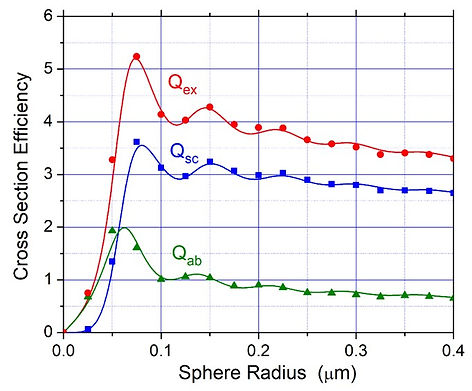
The FDTD near field calculation is used to calculate the far field cross section efficiencies (data points) and compared to the results of Mie theory (solid lines) for a gold sphere at a wavelength of 550 nm.
The FDTD near field calculation is used to calculate the angular dependence of the scattered field intensity for a 120 nm silver sphere at a wavelength of 360 nm.

The FDTD calculation is used to find the near field for an array of split ring resonators using periodic boundary conditions. This metamaterial exhibits an electric dipolar resonance at a wavelength of 0.7 microns a magnetic-like quadrupole resonance at a wavelength of 1.4 microns.

*Note: all plots are generated using commercial graphics software from the text data output of the program though presentation quality graphics on the screen are also generated by the program.